 Jen HoldenLicense ID:639966
- +1(443) 803-7620 jen@thejenholdengroup.com
What Maryland Landlords Need to Know About TOPA When Selling a Tenant-Occupied Property
Maryland’s Tenant Opportunity to Purchase Act (TOPA): What Landlords Need to Know When Selling Tenant-Occupied Homes
If you’re a Maryland investment property owner thinking about selling a home that tenants currently occupy, there’s an important new law you need to know about. In late 2024, Maryland enacted the Tenant Opportunity to Purchase Act (TOPA) – a law that essentially gives your tenant the right of first refusal to buy the property before anyone else can. In other words, before you list your tenant-occupied house for sale or even negotiate with another buyer, you must first give your tenant a chance to purchase it. This added step might sound daunting if you’ve never heard of it, but don’t worry – in this post, we’ll break down what TOPA means, how it works, and how you can navigate it smoothly.
What Is TOPA and Why Does It Matter?
TOPA stands for Tenant Opportunity to Purchase Act. Think of it as Maryland’s way of giving renters a fair shot at becoming homeowners if the house they’re renting goes up for sale. Effective October 1, 2024, this law requires landlords selling a residential rental property (generally single-family homes or small rentals) to notify their tenant in writing before selling and give that tenant the first opportunity to buy the home. The idea is to prevent tenants from being blindsided by a sale and possibly displaced – instead, they get a window of time to decide if they want to purchase the property themselves.
For landlords and real estate investors, TOPA introduces a new legal obligation in the selling process. It means you can’t just put your tenant-occupied property on the market or accept an offer from a third-party buyer without going through your tenant first. Failing to follow this procedure can lead to serious complications – you could face financial penalties and even legal action from the tenant if you ignore their TOPA rights. But with a clear understanding of the rules (and the right guidance), you can comply with the law and still have a successful sale.
How Does TOPA Affect the Sale of a Tenant-Occupied Property?
Here’s a quick rundown of what TOPA requires when you’re selling a rental home with a tenant in place:
-
Notify the Tenant in Writing – Before listing the property or negotiating with any other buyer, you must inform your tenant (or tenants) in writing of your intent to sell. This written notice should clearly state that you plan to sell the home and that the tenant has the right to purchase it if they choose. It’s best to deliver this notice in a way that provides proof (for example, certified mail or an email with receipt confirmation), so there’s a record that the tenant was informed. The notice should also outline basic details, like how the tenant can respond and how long they have to decide.
-
30-Day Right-of-First-Refusal Period – Once you’ve notified the tenant, you must give them an exclusive 30-day window to decide if they want to buy the property and to make an offer. During this 30-day period, you cannot list the home on the open market or accept offers from other buyers. Essentially, the tenant gets first dibs. They can take this time to consider financing, inspect the property, and put together an offer. The tenant’s offer doesn’t necessarily have to match your “dream price” for the home, but it should be made in good faith. As the seller, you’re not obligated to accept an unreasonable low-ball offer – but you do need to give the tenant a fair chance to negotiate.
-
Review the Tenant’s Offer (If Any) – If the tenant decides to make an offer within the 30-day period, you then have a short timeframe (about 5 days per the law) to respond to that offer. You can accept the offer, negotiate the terms, or decline it. If you reach an agreement – great, you’ve found your buyer without ever hitting the market! If you don’t reach an agreement (or if the 30 days pass with no offer from the tenant), you’re then free to proceed with selling the property to someone else. At that point, you can list the home publicly and entertain offers from other buyers as you normally would.
-
Proceed with the Sale (Tenant Declines or Time Expires) – After the tenant has either declined to buy or failed to make an offer in the 30-day window, you can move forward and put the property up for sale on the open market. It’s a good practice to document the tenant’s response (or lack thereof) – for instance, if they sent a written declination or if the 30 days simply elapsed with no response. This documentation can be important later (for example, to show a title company or any other party that you complied with TOPA’s requirements). Only after giving the tenant this first chance can you sell to someone else.
Compliance Tip: Make sure to keep records of everything – the notice you sent, when you sent it, any tenant reply, and the dates. If there’s ever a question about whether you followed the law, having this paper trail will be invaluable. Also, note that certain sales (like transfers to family, foreclosures, or inheritance situations) might be exempt from TOPA, but most standard sales of tenant-occupied homes will need to follow these rules.
By following these steps, you respect your tenant’s rights under TOPA and protect yourself as a seller. It might add a few extra weeks to your sale timeline (at minimum the 30 days), but it’s a necessary step now in Maryland. Skipping it isn’t worth the risk – ignoring TOPA could result in a $1,000 fine and even give the tenant grounds to sue for damages, which would be a far bigger headache than simply doing things by the book from the start.
Real-Life Example: Navigating a Tenant-Occupied Sale in Severna Park
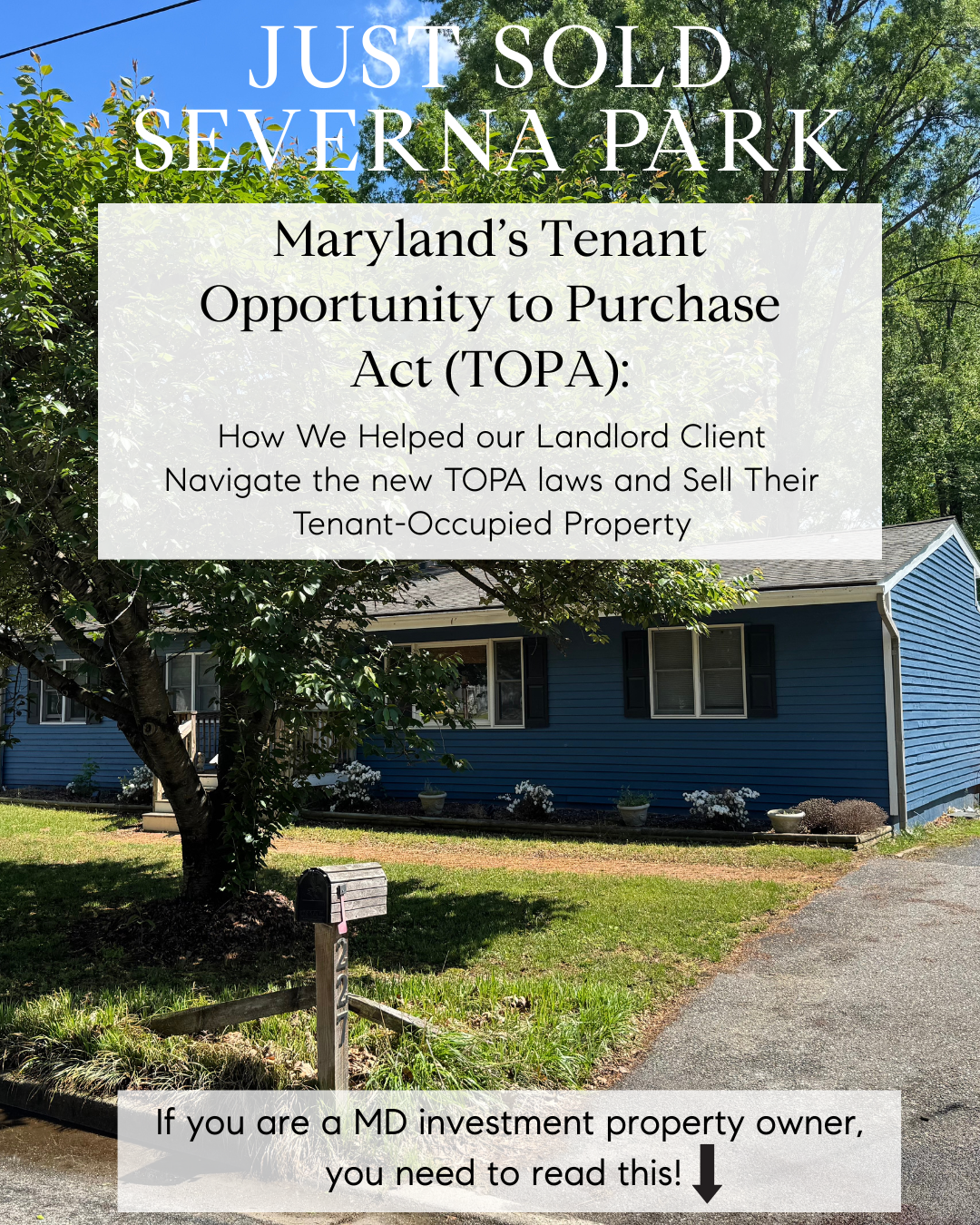
To see how TOPA plays out in practice, let’s look at a real example. Recently, our team at The Jen Holden Group helped a repeat investor client sell a rental property at 227 Cypress Creek Rd in Severna Park. This property was tenant-occupied, so from day one we knew that TOPA would be a crucial part of the process. Our client, being an experienced investor, was new to this particular law (it was still relatively fresh on the books), so we took the time to educate them about their obligations under TOPA and map out a game plan.
Step 1: Educating and Planning: We began by explaining to our client that before we could put a “For Sale” sign in the yard or list the home on the MLS, we needed to notify the tenants about the sale and give them the opportunity to purchase the property first. Together, we prepared a clear and courteous written notice to the tenants. The notice stated that the owner intended to sell the home and informed the tenants of their right of first refusal to buy it. We made sure the notice included how the tenants could respond if they were interested, and we sent it via certified mail so there’d be a record of delivery. Our client was on board with this plan – they understood it was not just required by law, but also the respectful thing to do for the tenants who had been living there.
Step 2: Tenant’s Decision Period: After the tenants received the notice, we marked our calendar for the 30-day TOPA period and advised our client to sit tight on any other sale efforts. During this time, we stayed available to the tenants to answer questions. We also communicated with the tenants in a friendly way, letting them know that if they were interested in buying, we were open to discussing an offer. In this Severna Park case, the tenants appreciated the heads-up and the chance to consider their options. Ultimately, they decided not to pursue purchasing the home (buying a house wasn’t in their plans at the moment). They provided a written statement declining the purchase, which we added to our file for documentation.
Step 3: Moving Forward with the Sale: With the 30 days elapsed and the tenants officially declining their opportunity to buy, we were free to put 227 Cypress Creek Rd on the market. Because we had handled the TOPA requirements upfront, there was no cloud of uncertainty over the sale. In fact, when we found an outside buyer and went under contract, we were able to assure that buyer that the tenant’s rights had been fully respected and waived, so there wouldn’t be any surprises down the line. This assurance made the property even more attractive, as the new buyer could proceed confidently.
Step 4: Smooth Sailing to Settlement: One of the biggest benefits of doing things right was evident at the closing table. We proactively collaborated with KVS Title, the title company handling the settlement, to make sure all TOPA-related documentation was in order. We provided the title company with proof of the tenant notice and the tenants’ declination, so they were satisfied that the sale complied with Maryland law. As a result, the title company had no issues insuring the title and completing the transfer. The settlement went off without a hitch, and our client successfully sold the property. They were relieved – not only because we found a buyer at a great price, but because the whole process went through without any legal hiccups or last-minute delays. By guiding our client through the TOPA steps, we essentially eliminated a potential roadblock that could have derailed the sale if it had been overlooked.
Expert Guidance Through Changing Laws
The story of 227 Cypress Creek Rd highlights a key point: having a knowledgeable real estate team in your corner makes all the difference, especially when dealing with new or complex laws like TOPA. Real estate regulations can change, and what you don’t know can hurt you (or at least complicate your life!). Our team prides itself on staying current with evolving legal requirements – we make it our business to know the latest rules, so our clients are always a step ahead. In the case of TOPA, we had done our homework as soon as the law passed, which meant we could immediately advise our clients and prevent any missteps.
When you’re selling an investment property with tenants, there are a lot of moving parts to consider. You’re balancing your goal of selling at a good price, the tenants’ rights and timeline, and the need to keep the transaction attractive to potential buyers. It’s a delicate dance, but it’s one we’re very familiar with. We coordinate among all parties – from the tenant, to you as the seller, to the buyer, and even the title company and attorneys – to ensure everyone is on the same page and all legal boxes are checked. This collaborative and proactive approach means no unwelcome surprises at settlement.
At The Jen Holden Group, we’ve successfully guided repeat investors and first-time landlords alike through processes like TOPA. Our goal is to make your life easier by handling the complexities behind the scenes. So if you’re thinking about selling a tenant-occupied property (or just want to understand how laws like TOPA might affect your real estate decisions), we’re here to help. With the right preparation and expert guidance, you can comply with the law and achieve a great outcome – your tenant is treated fairly, and you sell your home with confidence.
Jen Holden, Realtor® | Principal
The Jen Holden Group of Compass
📱 443.803.7620 (m) | 📞 410.429.7425 (o)
✉️ jen@thejenholdengroup.com
🌐 www.movewithjhg.com
Sources:
-
Maryland General Assembly. HB0691 - Real Property – Residential Real Estate Transactions – Rights of Purchase for Tenants. Enacted October 1, 2024. https://mgaleg.maryland.gov/mgawebsite/Legislation/Details/hb0691
-
Maryland REALTORS®. TOPA - Tenant Opportunity to Purchase Act Resources. https://www.mdrealtor.org/Advocacy/Issues/TOPA
-
Maryland Legal Aid. Tenant Opportunity to Purchase (TOPA): Know Your Rights. https://www.mdlab.org/topa-rights/
-
Maryland State Bar Association. Overview of the Tenant Right of First Refusal Law. https://www.msba.org
Categories
Recent Posts